How Professional Studios Combine Clay and Digital Tools
The real hybrid process behind modern car design

Why do professional design studios still use clay when digital tools are so advanced?
Digital tools excel at precision, speed, and data management, but clay remains valuable because it allows designers to evaluate form, proportion, and surface quality under real lighting and at human scale. Many studios use a hybrid process where clay and digital work together rather than replacing each other.
How does the modern hybrid clay-and-digital design process work?
Designers typically begin with sketches or early digital concepts, develop form in clay, scan the clay model into the computer, refine the surfaces digitally (often in Alias or similar tools), and frequently mill a new clay model from the digital data for final evaluation. This back-and-forth improves both creative judgment and technical accuracy.
What is the role of clay modeling in today's digital design workflow?
Clay modeling serves as a critical physical checkpoint. It helps designers assess volume, surface tension, light reflection, and emotional impact in ways that screens cannot fully replicate. Even in highly digital studios, clay is still used to validate and refine designs before final decisions are locked in.
Is clay modeling still relevant for industrial designers working primarily in digital tools?
Yes. Even designers who work mostly digitally benefit from understanding clay modeling because it trains the eye for proportion, surface quality, and three-dimensional form. Many professional studios still expect designers to be able to evaluate and communicate with physical models.
What software is commonly used with clay in the hybrid process?
Alias is the most widely used professional tool for refining scanned clay models into precise digital surfaces, though other programs are also used depending on the studio.
How Professional Studios Combine Clay and Digital
Most people assume car design is now fully digital. In reality, the best automotive design studios still rely on a back-and-forth between physical clay and digital tools. This hybrid process remains one of the most effective ways to develop strong vehicle forms.
1. The Starting Point: Ideas and Sketches
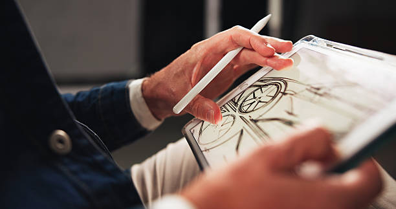
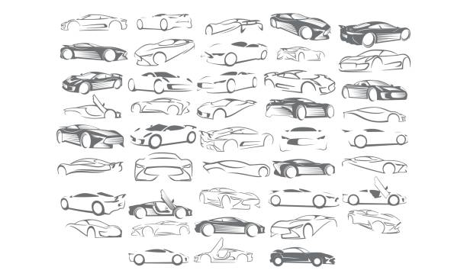
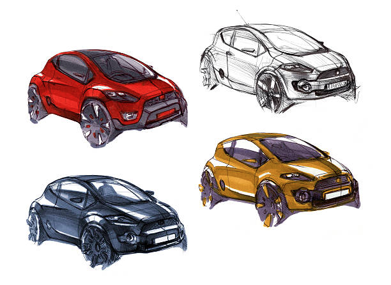
Design usually begins with 2D sketches and quick digital concept work. Designers explore proportions, gesture, and character through hand sketches or digital tablets, rapidly generating many variations to find promising directions. These early drawings allow the team to discuss overall attitude, stance, and visual theme before committing to more time-intensive work.
Even at this early stage, physical exploration still has value. Simple clay or foam studies help designers quickly test volume, stance, and three-dimensional presence in ways that sketches alone cannot fully reveal. A sketch may look dynamic on paper, but a basic physical model can immediately show whether the proportions feel grounded, top-heavy, or unbalanced. These quick studies often expose issues with mass distribution or silhouette that are difficult to judge accurately in two dimensions.
By combining fast 2D ideation with early physical checks, designers gain a clearer understanding of the form before moving into more refined clay models or detailed digital work.
First Clay Model — Exploring Form
How rough scale models establish proportion, volume, and the overall gesture of a vehicle design.
Where the Design Begins in Three Dimensions
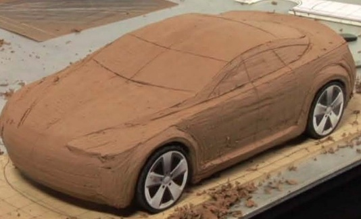
The first clay model is where the design begins to exist in three dimensions. At this stage the goal is exploration rather than perfection. Designers and modelers use clay to test overall proportions, volumes, and the basic gesture of the vehicle. Because clay can be added or removed quickly, ideas can be tried, judged, and changed in real time.
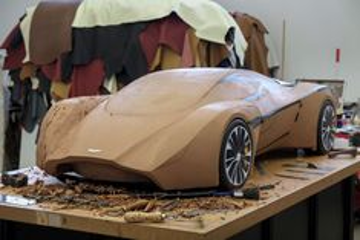
What the Physical Model Reveals
This early physical model often reveals problems or opportunities that were not obvious in sketches or digital concepts. It establishes the foundational volumes and stance that later digital work will refine. Working in clay at this stage keeps the design process open and responsive, allowing the team to make significant changes before the form becomes locked into precise digital data.
Scanning the Clay
How physical clay models are digitized to carry the designer's intent into precise computer tools.
Capturing the Surface in High Resolution
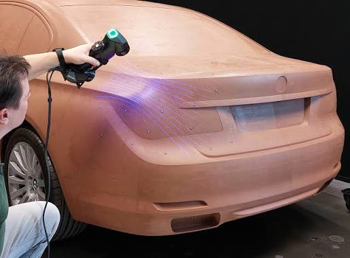
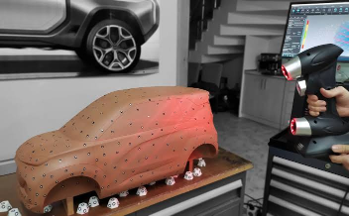
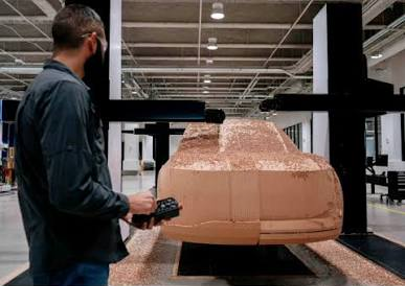
Once the clay model reaches a useful stage, it is scanned to create an accurate digital version. High-resolution scanners capture the surface so the physical work can be brought into the computer. This step allows the design to move into precise digital tools while preserving the form decisions already made in clay.
Bridging Clay and Digital Precision
The scanned data becomes the starting point for digital surfacing. It carries the designer's physical intent into the computer, where the model can be measured, refined, and prepared for engineering requirements. Scanning bridges the gap between the free, exploratory nature of clay and the controlled precision of digital modeling.
Digital Refinement
How scanned data is cleaned and developed into precise digital surfaces using professional modeling software.
Cleaning and Developing Controlled Surfaces
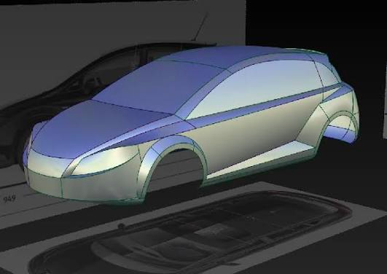
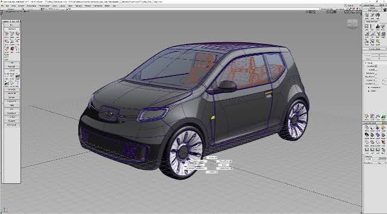
In the digital environment, the scanned data is cleaned and developed into controlled surfaces. Programs such as Alias are used to refine character lines, improve surface quality, and begin incorporating engineering constraints. Digital tools excel at precision, consistency, and the ability to evaluate multiple variations quickly.
Precision, Proportion, and Engineering Alignment
At this stage, designers and digital modelers can adjust proportions with exact measurements, create continuous high-quality surfaces, and check the model against packaging and technical requirements. The digital model becomes a precise representation of the design that can be shared, analyzed, and prepared for the next physical stage.
Returning to Clay
How digitally refined designs are milled back into physical clay models to be judged under real lighting and at full scale.
Unlock All 15 ChaptersMilling a New Clay Model from Digital Data
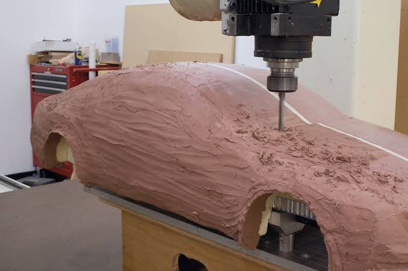
After digital refinement, many studios mill a new clay model from the updated computer data. This returns the design to the physical world so it can be judged again under real lighting and at full scale. Designers look for issues in reflection, surface tension, and overall presence that are difficult to evaluate fully on a screen.
A Critical Checkpoint in Physical Space
The milled clay model becomes a critical checkpoint. It allows the team to assess whether the refined digital surfaces still feel right in physical space. Adjustments made at this stage often lead to further digital updates, creating a productive loop between precision and human judgment.
The Loop Between Precision and Human Judgment
This iterative cycle — from clay to digital and back to clay — is central to the hybrid design process. Each pass through the loop brings the design closer to a form that satisfies both engineering requirements and the designer's eye. The physical model remains the final arbiter of quality.
Final Refinement Loop
How clay and digital roles work in close partnership to bring the design to its final resolved state.
Moving Between Clay and Digital
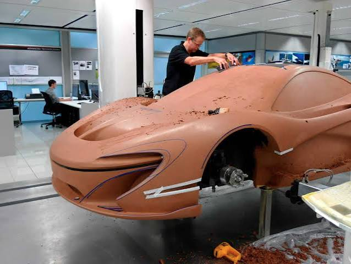
The process often moves back and forth several times between clay and digital. Clay modelers focus on form, surface quality, and the physical feel of the design. Digital modelers focus on precision, data integrity, and technical requirements.
A Partnership of Complementary Strengths
The two roles work in close partnership. The clay modeler protects the design's emotional and visual quality, while the digital modeler ensures the surfaces are accurate, buildable, and ready for engineering. This collaboration is one of the strengths of the modern studio process.
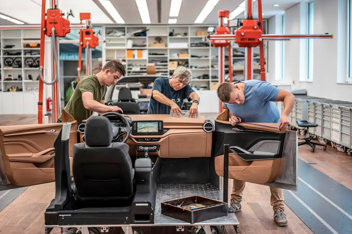
Why the Hybrid Process Still Wins
How the combination of clay and digital tools produces results stronger than either approach could achieve alone.
Speed, Precision, and Human Judgment
Digital tools deliver speed, precision, and the ability to manage complex data. Clay delivers the human judgment that still decides whether a design feels right. The strongest studios do not choose one method over the other. They move deliberately between both.
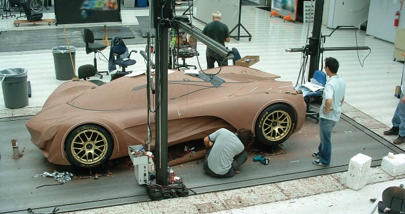
Stronger Together
When clay and digital work together, the result is stronger than either approach could achieve alone. Understanding this hybrid process helps explain why professional clay modeling remains a valuable foundation for designers, even in a digital age.
Digital Modeling Courses
3D Cars: Inside and Out – CG Masters
Comprehensive hard-surface car modeling course in Blender. Strong production-focused training used by professionals in automotive visualization.
3dcarsacademy.com ↗Alias Subdivision for Car Designers – leManoosh
Practical Autodesk Alias course focused on fast concept modeling for car designers, bridging creative exploration with professional digital tools.
lemanoosh.com ↗Rhino 3D for Industrial Designers – leManoosh
Professional Rhino training focused on clean surface modeling for industrial and product design, with skills that transfer well to automotive work.
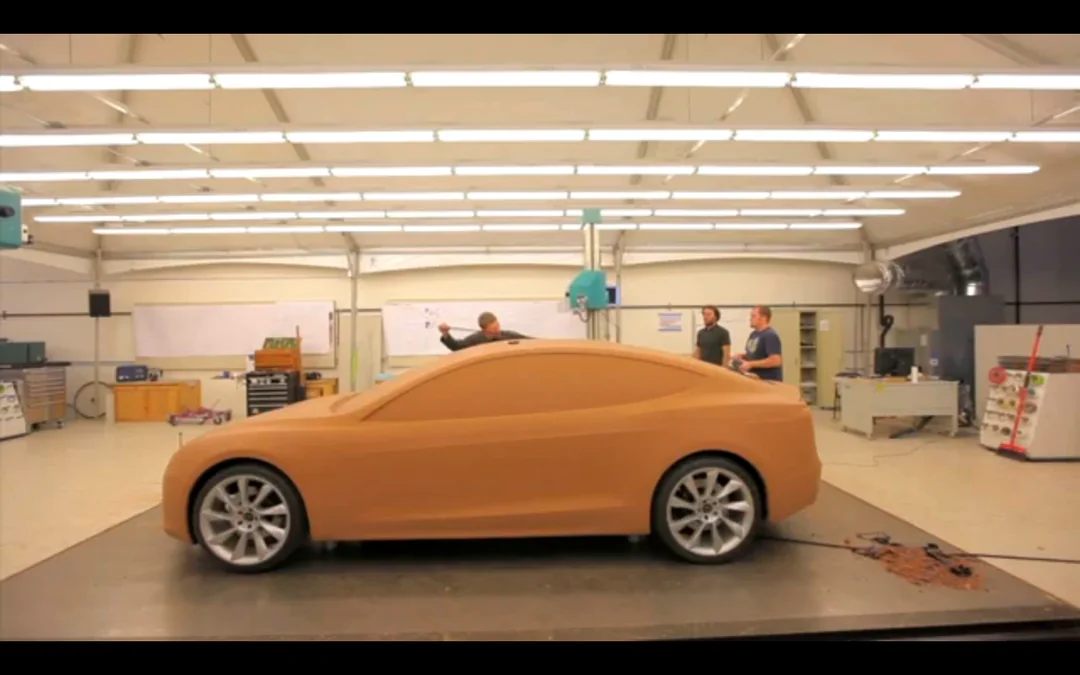
lemanoosh.com ↗This page is dedicated to my old boss Franz von Holzhausen, Tesla chief designer. Thank you for allowing me to be part of both the Mazda Furai and Tesla S design teams. Also, a quick shout out to “little buddy” Ramsy, and Crash (as seen in the Tesla S image above). Hope you all are well.